
- Media
Understanding the Golden Triangle Economic Zone

Geography and trade history
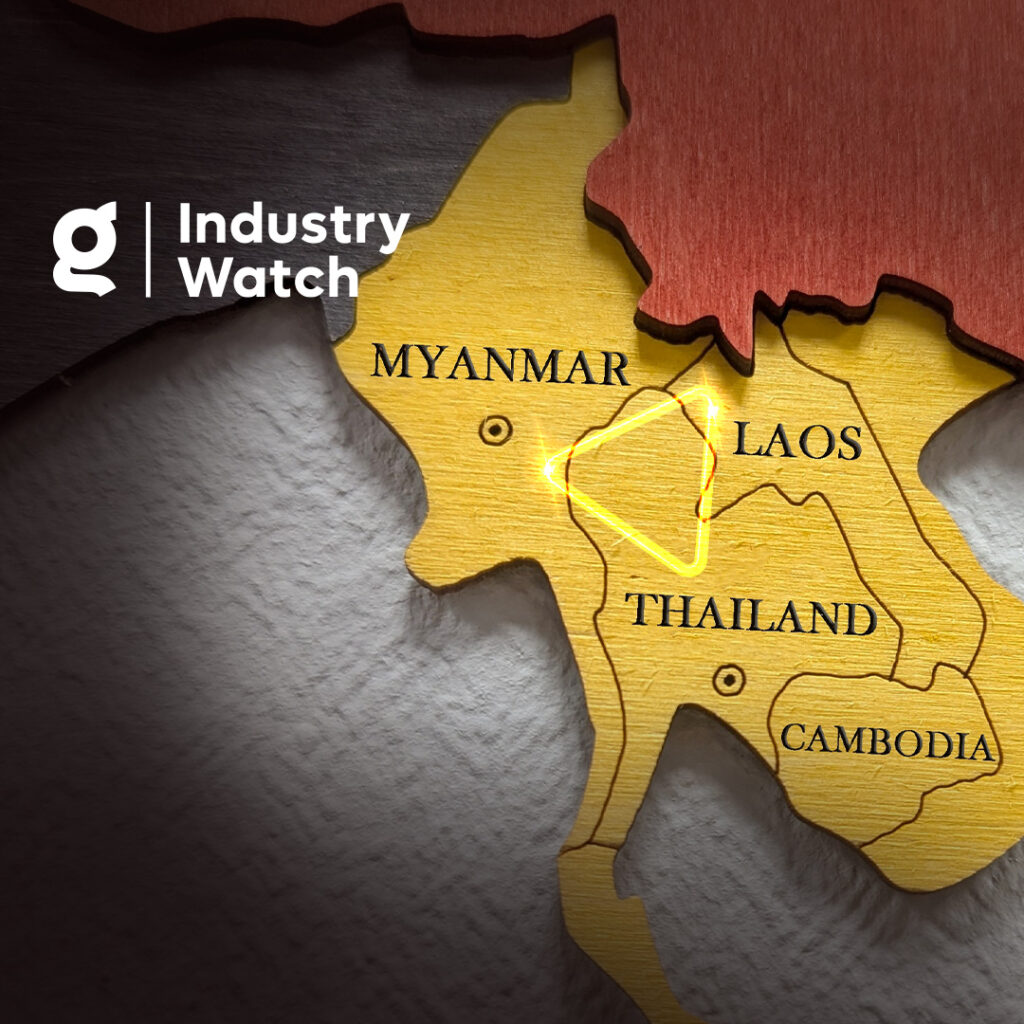
The Golden Triangle refers to the remote borderlands where Thailand, Laos and Myanmar converge, a region long defined by weak state control and cross-border trade. Its strategic location at the confluence of the Mekong and Ruak rivers made it a natural commercial hub centuries before it became synonymous with crime. Indigenous communities farmed and traded here for generations, while Chinese merchants later integrated the area into wider regional trade routes.
From opium to modern criminal economies
That history took a decisive turn in the 19th and 20th centuries, when colonial expansion and conflict helped entrench the Golden Triangle as a centre of opium production. By the 1970s, the region had become one of the world’s primary sources of heroin, with armed groups, militias and traffickers exploiting mountainous terrain and porous borders to operate beyond the reach of central governments. When heroin declined, the infrastructure physical, financial and political remained.
In the past decade, that infrastructure has been repurposed. The Golden Triangle Special Economic Zone in northwest Laos, controlled by the Kings Romans Group and founded by Chinese businessman Zhao Wei, became emblematic of a new phase of criminal enterprise. Casinos, hotels and entertainment complexes provided both revenue and cover, while online scam operations, human trafficking and money laundering flourished behind a façade of investment and development.

Businesses behind the zone
Behind these operations sit a small group of powerful businessmen who have turned cyber fraud into a transnational industry. Figures such as Zhao Wei and other casino and property magnates across Laos, Cambodia and Myanmar control the land, infrastructure and security that scam networks rely on. Western and Asian authorities say these individuals operate less like traditional criminals and more like corporate executives, using holding companies, special economic zones and cross-border investments to insulate themselves from legal risk while outsourcing violence and coercion to intermediaries.
Sanctions imposed by the United States and the United Kingdom have increasingly targeted these figures, signalling a shift away from arresting low-level operatives toward disrupting the financial and political foundations of the scam economy.
Casino crackdowns and international pressure
International pressure has intensified. Sanctions imposed by the United States and the United Kingdom, coupled with coordinated crackdowns by Chinese and Southeast Asian authorities, appear to have disrupted operations inside the zone. The Telegraph reported shuttered buildings, discounted hotels and a sharp fall in population, alongside the departure of many online scam centres that once powered the enclave’s economy.
Limits of enforcement
Yet history suggests caution in declaring the death of the Golden Triangle economic zone. The region has repeatedly survived crackdowns by adapting rather than disappearing, shifting from opium to methamphetamine, and more recently to cyber-enabled fraud. Analysts warn that enforcement actions often displace criminal activity to new locations rather than dismantling the networks behind it.
Whether the current downturn marks a genuine collapse or a temporary retreat will depend less on visible raids than on sustained political will. As long as governance gaps persist, semi-autonomous zones operate with limited oversight, and local authorities remain economically reliant on illicit capital, the Golden Triangle is unlikely to vanish.
What may be ending is not the Golden Triangle itself, but a particular model of how its economy operates. The question now is whether that model will be replaced by regulation and reform, or by yet another iteration of organised crime, rebuilt just out of sight.

