
- Media
Nevis tests the water of gaming regulation


Nevis joins a growing number of small jurisdictions turning to gaming licences as a tool for economic diversification. For such markets, credibility must be built early and decisively. When a gaming jurisdiction loses its reputation, it rarely recovers. With the launch of its new licence, the Caribbean island is positioning itself as a serious regulatory jurisdiction, aiming to draw international operators without diluting oversight, even as larger markets tighten regulatory controls.
“This is about building something credible from the outset,” Brantley said. “We want to do it properly, we want to do it responsibly, and we have a long-term vision.” The licence reflects an effort to build a durable regulatory framework at a time when global operators are searching for viable alternatives to increasingly restrictive regimes.
iGaming jurisdictions in Caribbean
Drawing on more than four decades of financial services oversight, Nevis is shaping its gaming regime around established regulatory standards and compliance practices. The island is pitching itself as a disciplined offshore option, differentiated not by speed and flexibility, but by enforcement, transparency, and regulatory authority. “We’re going to apply the same rigour to gaming as we have to banking, trusts, and other financial services,” Brantley added.
Several Caribbean jurisdictions, including Antigua, Barbuda, and the Bahamas, have already developed recognised gaming frameworks. Others, operating under less stringent rules, have struggled with consistent oversight, with popularity often driven by accessibility rather than credibility. Against this backdrop, Nevis emphasises responsible gaming, robust compliance, and long-term stability, targeting operators that value legitimacy and international recognition.
Malta and the Isle of Man set gold standard
Against this backdrop, Nevis is positioning itself as a measured entrant, emphasising responsible gaming, robust compliance and long-term stability. The target audience is operators that value legitimacy and international recognition.
“Of course, there are well-established markets such as Malta and the Isle of Man that have done very well, alongside emerging jurisdictions like Anjouan that are still finding their place,” Brantley said. “I don’t see Nevis as a competitor. I see it as another jurisdiction stepping into the space with an emphasis on responsibility and getting the foundations right.”
In both cases, policymakers are seeking to capture the economic upside of online gaming while avoiding the cultural, social and urban consequences associated with land-based casinos, a model that is increasingly relevant for smaller or socially conservative markets.
Online-only strategy
Nevis has opted to forgo land-based casinos, focusing instead on a tightly defined online-gaming strategy. While neighbouring St Kitts hosts physical casinos, Brantley cited the island’s small population and the potential social impact of brick-and-mortar venues.
This approach aligns Nevis with a small but notable group of jurisdictions prioritising digital gambling. Brazil provides a prominent parallel: despite prohibitions on land-based casinos, it regulated a nationwide online betting and casino market in 2024 – 2025, capturing revenue potential without reopening politically sensitive debates over physical gaming halls.
Industry response
Early reactions from industry stakeholders have been encouraging. Brantley described the interest as “quite phenomenal” and said he was “overwhelmed” by the opportunity to meet operators and advisors. He highlighted the value of direct, one-on-one discussions with professionals in the sector, noting that the response so far has been positive.
Yet translating enthusiasm into sustainable operator commitments remains the challenge. Nevis’s small size, limited infrastructure, and offshore positioning mean it will face competition from more established jurisdictions. Brantley remains optimistic, stating that by collaborating with industry partners, “we can create something special on the island and in the Caribbean,” though the scale and pace of uptake will likely determine the long-term impact of the new licence.
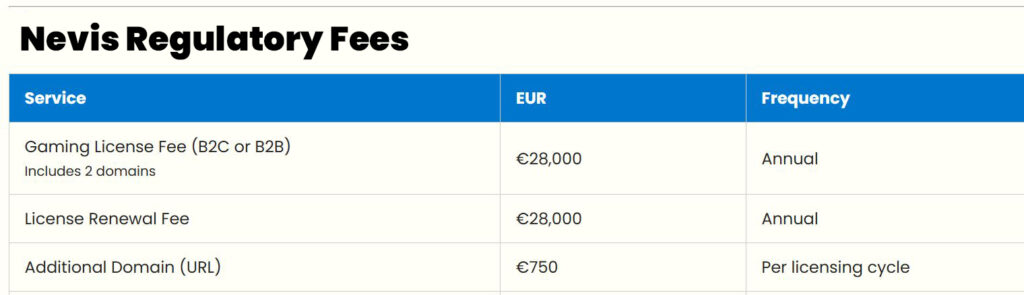
Nevis’s iGaming licences carry a flat annual fee of €28,000 for both B2C and B2B operators, with the same amount charged for renewal. The simple, predictable fee structure makes budgeting straightforward and is competitive for smaller operators in the emerging online gaming market.
Addressing the importance of investing in the next generation, Hon. Mark Brantley said, “We have a population that’s youthful, that’s tech savvy, that’s incredibly bright, and we therefore want to create new opportunities for them as well.”
The success of Nevis’s gaming licence will ultimately rest on whether its emphasis on credibility and long-term vision can deliver lasting economic impact.
Stay ahead in leadership with the latest insights from industry experts. Subscribe today.
