
- Media
Analysis: Denmark’s gambling surge


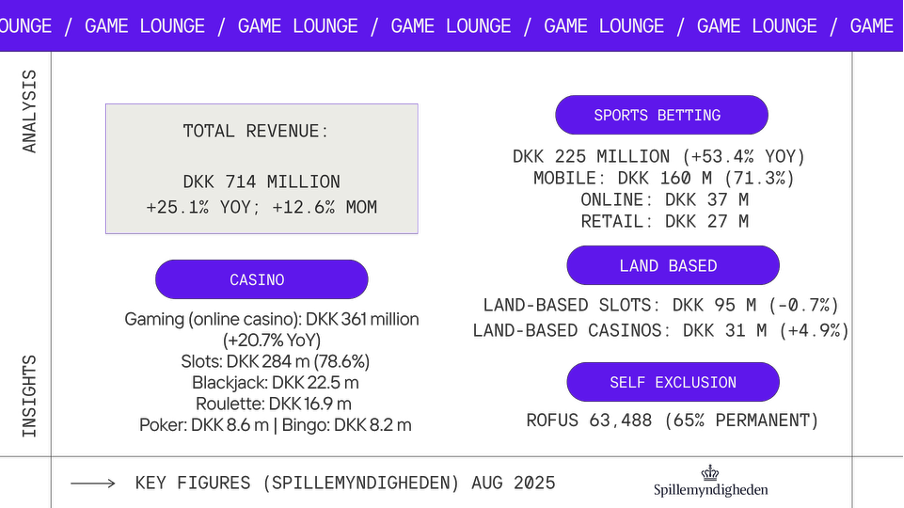
Denmark’s gambling market reveals a striking transformation with total gambling revenue reaching DKK 714 million, marking a 25.1 percent increase from the previous year. This surge, driven predominantly by mobile sports betting and online casinos, highlights a major change in how the gambling market is evolving.
For policymakers, Denmark’s experience offers valuable insights. The balance between regulation and innovation is delicate; overly stringent measures could stifle growth, while leniency might compromise consumer protection. The Danish model suggests that a well-calibrated approach can yield both economic and social benefits.
Industry stakeholders should note that while the current growth trajectory is promising, it necessitates ongoing investment in technology and compliance. The emphasis on mobile platforms and online casinos requires continuous innovation to maintain consumer interest and adhere to regulatory standards.

As digital matures, land-based stagnates
The most pronounced change is the impact of mobile sports betting. In August, mobile platforms accounted for 71.3 percent of all sports betting revenue, reflecting a broader trend towards on-the-go wagering. This shift is not merely technological but behavioural, as consumers increasingly favour the convenience of mobile interfaces.
Concurrently, online casinos have solidified their position as the primary revenue stream, with slots leading the charge. This contrasts sharply with the stagnation observed in land-based gambling, where slot machine revenues declined by 0.7 percent, and casino revenues experienced modest growth of 4.9 percent.
Comparison with Denmark’s Nordic neighbours
Denmark’s recent performance becomes more striking when placed beside its Nordic peers. Sweden, which liberalised its gambling market in 2019 under the Gambling Act (SFS 2018:1138), continues to face regulatory and structural headwinds. Channelisation, the share of gambling through licensed domestic operators, slipped to about 85 per cent in 2024, reflecting persistent offshore activity. Operators face an 18 per cent tax on gross gaming revenue and stringent compliance demands, including deposit caps, self-exclusion mechanisms through Spelpaus, and strict bonus limits. While the Swedish model is robust in consumer protection, its heavy oversight and high compliance costs have curbed agility. Proposed reforms, such as a ban on credit-funded gambling and tighter rules on foreign operators, could reinforce integrity but may further weigh on growth.
Norway remains the regional outlier, retaining a state-monopoly system dominated by Norsk Tipping and Norsk Rikstoto. The model ensures high control and stable revenue, turnover from state operators rose to NOK 3.1 billion in 2024, but stifles innovation. The absence of private-sector competition limits digital expansion and product diversity, while mounting industry pressure for a licensing regime highlights growing tension between policy stability and market dynamism.
Finland, meanwhile, is in transition. The government plans to dismantle Veikkaus’s monopoly and introduce a licensing framework by 2027, following years of offshore leakage that saw up to half of online gambling spend leaving the regulated system. The reform, which proposes a 22 per cent tax on gaming revenue, aims to restore control and improve consumer safeguards through identity verification and self-exclusion measures. Yet, until implementation, Finland’s market remains constrained by structural inertia.
Against this backdrop, Denmark’s fully liberalised, digitally mature framework gives it a first-mover advantage. Its balance of regulation, competition and innovation distinguishes it as the Nordic benchmark for sustainable gambling growth.
Role of self-exclusion and responsible gambling
An essential component of Denmark’s gambling sector is the ROFUS self-exclusion register, which reached 63,488 participants. Notably, 65 percent opted for permanent exclusion, indicating a proactive approach to responsible gambling. This robust system not only protects vulnerable individuals but also reinforces the integrity of the market, ensuring that growth does not come at the expense of consumer welfare.

